Lessons from 10+ Hackathons: What Makes an Agentic AI Solution Win
Lessons from building Agentic AI in hackathons - how the right tools, rapid iteration, and human-AI collaboration turn ideas into working systems.
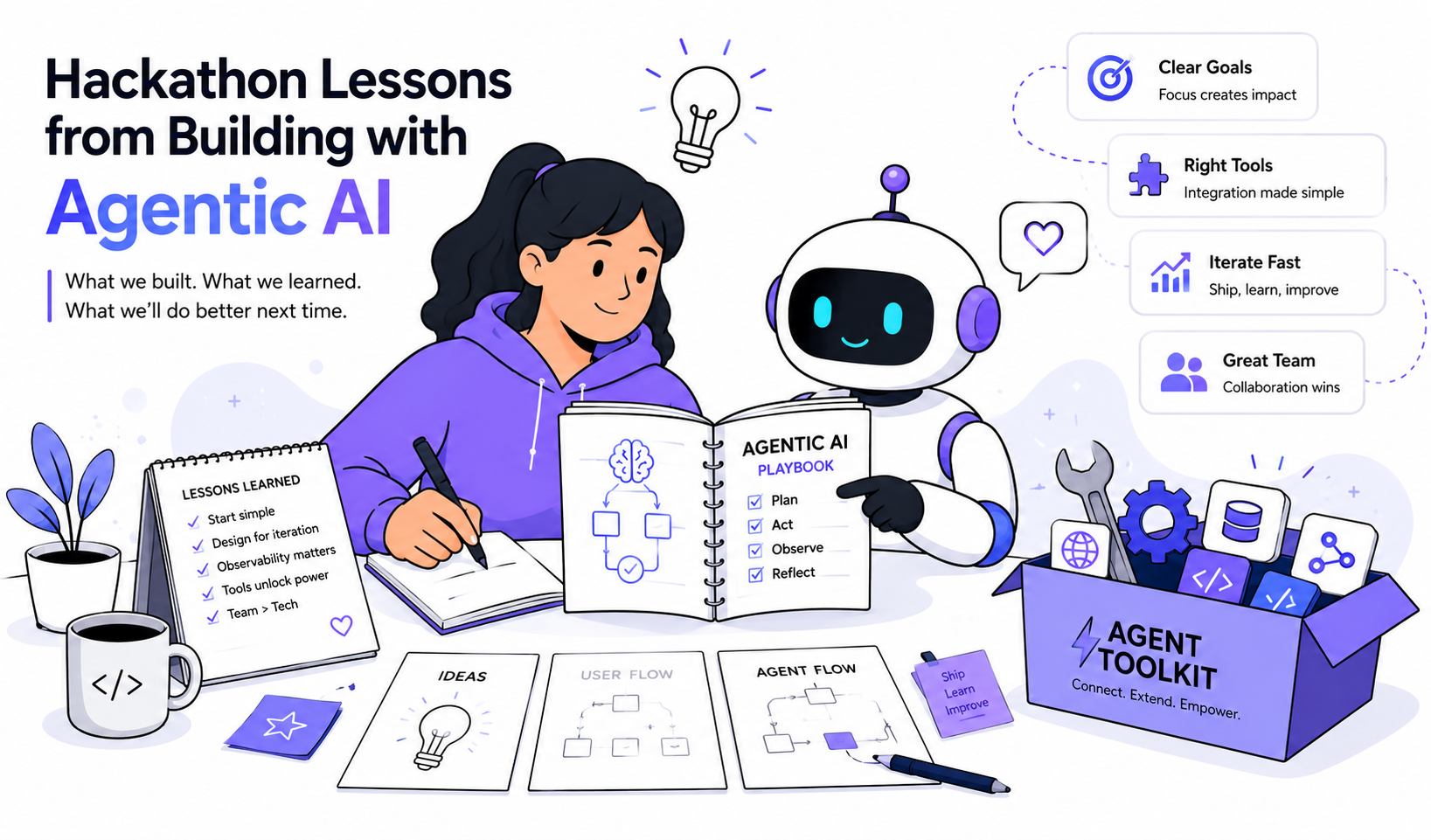
Hackathons are compressed versions of everything that matters in AI engineering: tight constraints, imperfect information, real-time decision-making, and a live demo that has to actually work.
After participating in 10+ AI hackathons — across Google Cloud, AWS, and other platforms — and finishing in the top positions in several, certain patterns emerge. The difference between winning solutions and the rest isn’t model selection or clever prompting. It’s architecture decisions, product thinking, and what you choose not to build.
The Mindset Shift That Changes Everything
Most teams approach hackathons as coding marathons — sprint to build the most features in the least time. Winning teams approach them as product sprints — ship one thing that works end-to-end.
A multi-agent system that flawlessly solves one well-defined problem beats a system with seven agents that kind of does five things. Judges evaluate coherent impact, not component count.
Before writing a line of code, answer these questions:
- What specific problem does this solve?
- Who has this problem right now?
- What does “solved” look like to a user?
- What’s the smallest system that delivers that value?
Write these down. They become your scope fence — when scope creep hits at hour 10, this document pulls you back.
Architecture Decisions That Matter Under Time Pressure
Start with the demo, not the architecture
Decide in the first 30 minutes what your demo will look like. Then build the minimum system that produces that demo. This sounds backwards — it isn’t.
The demo is the deliverable. Everything else is infrastructure. A well-designed architecture that has no working demo has zero value in a hackathon.
1
2
3
4
5
Hour 0-1:  Define problem + demo scenario (write it down)
Hour 1-3:  Build a working prototype (hardcoded, mocked, whatever)
Hour 3-6:  Replace mocks with real implementations
Hour 6-8:  Polish demo flow, handle edge cases
Hour 8+:   Documentation, slides, submission
If you don’t have a working demo by hour 6, cut scope — not sleep.
Choose boring infrastructure, novel application
The temptation is to use every new tool: the newest model, the freshest framework, the most exotic vector database. Resist this.
Novel infrastructure = unknown failure modes at 2 AM.
Safe infrastructure choices for hackathons:
- Models: Claude Sonnet (fast, reliable, long context) or Gemini 2.5 Flash (fast, multimodal)
- Agent framework: LangChain or Google ADK (large community, good error messages)
- Vector store: ChromaDB locally, Qdrant for production (minimal setup)
- Backend: FastAPI (20 lines to a working REST API)
- Frontend: Streamlit or a single-page HTML with fetch calls (no build step)
The novelty should be in what you build, not how you build it.
The 3-Agent Rule
First-time hackathon participants build 1 agent and call it an agent. Intermediate participants build 7 agents to show off the architecture. Winners build exactly as many agents as the problem requires — usually 3.
Here’s why 3 works:
- Orchestrator: takes the user request, plans the approach, delegates
- Specialist: does the core technical work (search, analysis, generation)
- Synthesizer: assembles the final output, handles formatting and presentation
More agents than this, and you spend your time debugging coordination rather than solving the problem.
1
2
3
4
5
6
7
8
9
10
11
12
13
14
15
16
17
18
19
20
21
22
23
24
25
# The 3-agent pattern that works reliably
orchestrator = Agent(
    role="Task Orchestrator",
    goal="Understand the user request and coordinate the specialist and synthesizer to produce the best output.",
    backstory="You break complex requests into clear, executable steps and delegate precisely.",
    llm=llm,
    allow_delegation=True,  # Orchestrator CAN delegate
)

specialist = Agent(
    role="Domain Specialist",
    goal="Execute the core technical task using available tools. Return raw results.",
    backstory="You are an expert at [domain]. You focus on execution, not presentation.",
    tools=[your_primary_tools],
    llm=llm,
    allow_delegation=False,  # Specialists don't delegate
)

synthesizer = Agent(
    role="Output Synthesizer",
    goal="Transform raw specialist outputs into a clear, structured, user-ready response.",
    backstory="You are a clear communicator who makes complex outputs accessible.",
    llm=llm,
    allow_delegation=False,
)
Build the fallback before the feature
Every agent system has a failure mode: rate limits, tool errors, model timeouts. In a hackathon demo, any unhandled failure in front of judges is devastating.
Before you build the happy path, write the fallback:
1
2
3
4
5
6
7
8
9
10
11
def safe_agent_run(executor, input: str, fallback_response: str) -> str:
    try:
        result = executor.invoke({"input": input}, timeout=30)
        return result.get("output", fallback_response)
    except TimeoutError:
        return "I'm taking longer than expected. Here's what I know so far: " + fallback_response
    except RateLimitError:
        return fallback_response
    except Exception as e:
        logger.error(f"Agent error: {e}")
        return fallback_response
The fallback can be a hardcoded response that covers your demo scenario. The goal is that the demo never crashes — it degrades gracefully.
Technical Patterns That Win Consistently
Real data beats mock data
If you can demo with real, live data — even limited — it’s exponentially more impressive than a polished demo with mocked data. Judges can tell. Users can tell.
For a crowd safety system: pull real publicly available event data. For a document Q&A system: use real publicly available documents in your domain. For a multi-cloud orchestration tool: demo against real (free-tier) cloud accounts.
The effort to get real data is usually 2-4 hours and worth every minute.
Multi-modal creates memorable demos
Text-only demos are forgettable. The moment you add voice, images, or video — the demo becomes visceral. Judges remember it.
If your use case has any natural multi-modal angle, build it:
- Voice input with Whisper → 3 lines of Python
- Image analysis with GPT-4o/Claude Vision → 5 lines of Python
- Video frame extraction → 10 lines of Python
1
2
3
4
5
6
# Voice-first input in 3 lines using OpenAI Whisper
import openai

def transcribe_audio(audio_path: str) -> str:
    with open(audio_path, "rb") as f:
        return openai.audio.transcriptions.create(model="whisper-1", file=f).text
Ship streaming before you ship features
Streaming responses make your demo feel dramatically faster and more impressive. A streaming response that takes 8 seconds feels better than a static response that takes 3 seconds.
1
2
3
4
5
6
7
8
9
10
11
12
13
14
15
# FastAPI streaming endpoint
from fastapi import FastAPI
from fastapi.responses import StreamingResponse

app = FastAPI()

@app.post("/chat")
async def chat_stream(request: ChatRequest):
    async def generate():
        async with llm.astream(request.message) as stream:
            async for chunk in stream:
                yield f"data: {chunk.content}\n\n"
        yield "data: [DONE]\n\n"

    return StreamingResponse(generate(), media_type="text/event-stream")
1
2
3
4
5
6
7
8
9
10
// Frontend: receive streaming response
const response = await fetch('/chat', {method: 'POST', body: JSON.stringify({message})});
const reader = response.body.getReader();

while (true) {
    const {done, value} = await reader.read();
    if (done) break;
    const text = new TextDecoder().decode(value);
    outputDiv.textContent += text.replace('data: ', '');
}
What Judges Actually Evaluate
After watching dozens of hackathon pitches and winning several, judges evaluate five things:
1. Real-world impact (highest weight) Not “could this be useful” — but “who specifically has this problem and how bad is it?” The best pitches name a real person (or type of person) and describe their problem in concrete terms.
2. Technical execution Does the demo work? Not just in theory — does it work right now, live, in front of us? Judges adjust for hackathon timelines, but a broken demo is a broken demo.
3. Appropriate use of the sponsor’s technology Every sponsor is running a hackathon partly to get developers using their platform. Demos that use the sponsor’s specific product in a central, non-trivial way score higher. Check the sponsor’s prize categories — they tell you exactly what they want.
4. Architecture clarity Can you explain how it works in 2 minutes? A clear diagram + 2-sentence explanation of each component signals engineering maturity. Judges ask “how would this scale?” — have an answer.
5. Demo polish The difference between 3rd place and 1st is often presentation. A clean UI, smooth demo flow, and confident delivery matter. Spend the last 2 hours polishing the demo, not adding features.
The Submission Checklist
1
2
3
4
5
6
7
8
[ ] Demo works end-to-end without manual intervention
[ ] Fallback handles all failure modes gracefully
[ ] Video demo recorded (2-3 minutes, no dead air)
[ ] Architecture diagram (Mermaid or draw.io, one page)
[ ] README covers: problem, solution, how to run, architecture
[ ] Devpost/submission includes all required sponsor technology mentions
[ ] Demo can be reproduced from repo (others can run it)
[ ] All API keys in .env, not hardcoded (no accidental key exposure)
Key Takeaways
- Define the demo before writing code — the demo is the deliverable
- Three agents is usually optimal — orchestrator + specialist + synthesizer
- Build the fallback before the feature — demos that never crash win
- Real data > mock data — 2 hours to get real data is always worth it
- Multi-modal + streaming = memorable demos — both are < 10 lines of code
- Judges evaluate real-world impact first — name a specific user with a specific problem
- Spend your last 2 hours on polish, not features — winning requires a great pitch, not a complete product
Part of the Agentic AI in Practice series — lessons from building production multi-agent systems.